
Your recipe says 24 hours. It never told you the temperature.
The retard didn't fail. The dial lied.
This one started with a question in the Academy during bagel week. A member has a refrigerator drawer that holds 33 degrees, right above freezing, and she wanted to know if that was too cold for the overnight proof. Then she asked the better question, the one that earns a whole Notebook entry.
Why is a slightly warm fridge a problem, but 48 hours in a cold one is fine?
Sit with that. It sounds backwards. Warm is only a few degrees off. Forty eight hours is double the time. Shouldn't the double be the danger?
No. And once you see why, you'll read every recipe you own differently. Here's what actually happens, and why the flat bagels were never your fault.
Time is not the measurement
Fermentation isn't measured in hours. It's measured in hours multiplied by temperature.
Think about driving. Sixty miles an hour for two hours and thirty miles an hour for four hours put you in the same parking lot. The clock was never the point. The distance was. A recipe hands you a duration, but that duration is quietly assuming a speed, and it never tells you what speed it assumed.
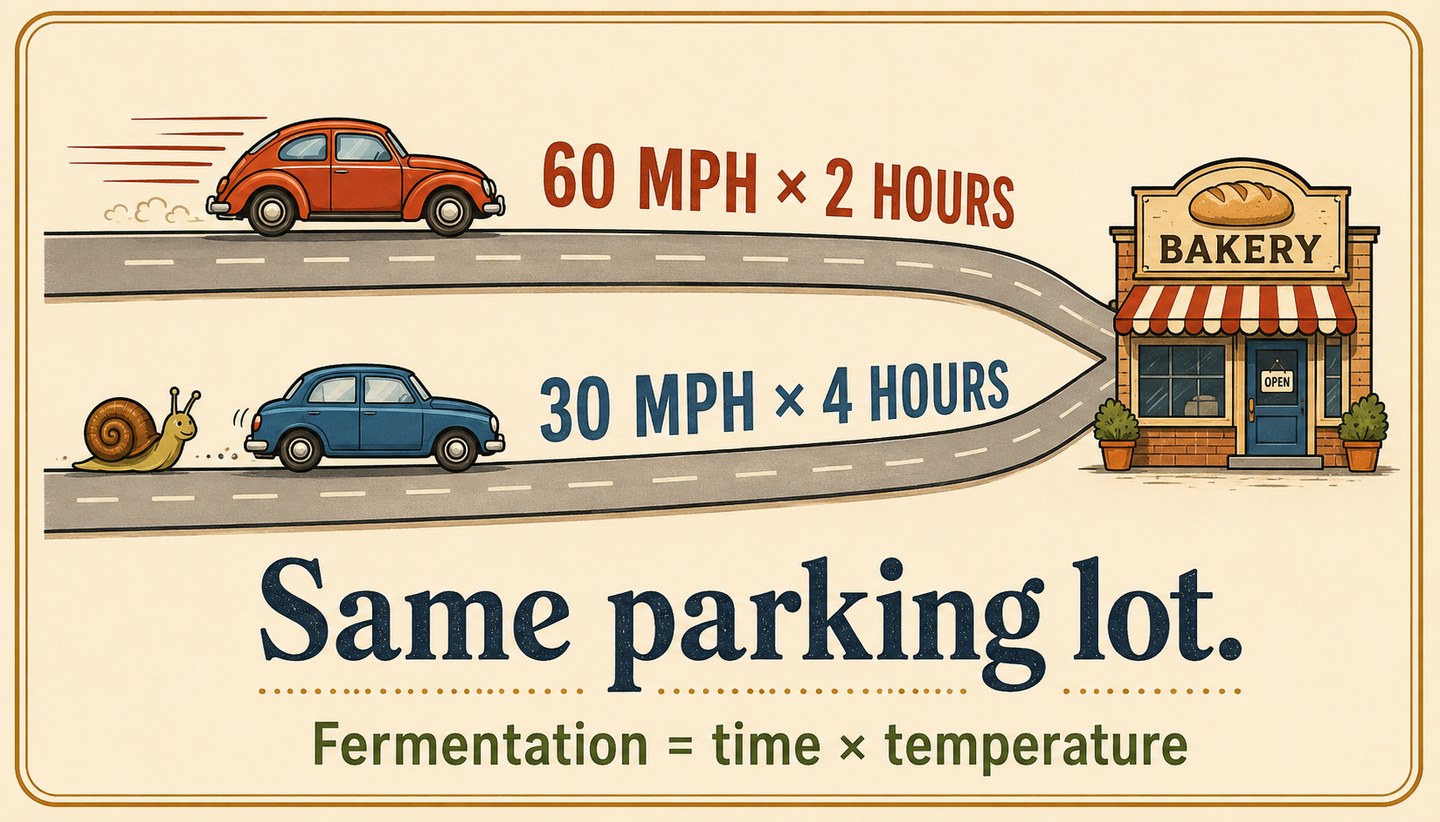
For cold fermentation, the assumed speed is a fridge holding around 37 to 40 degrees. That's the number hiding inside every "retard overnight" instruction you've ever followed.
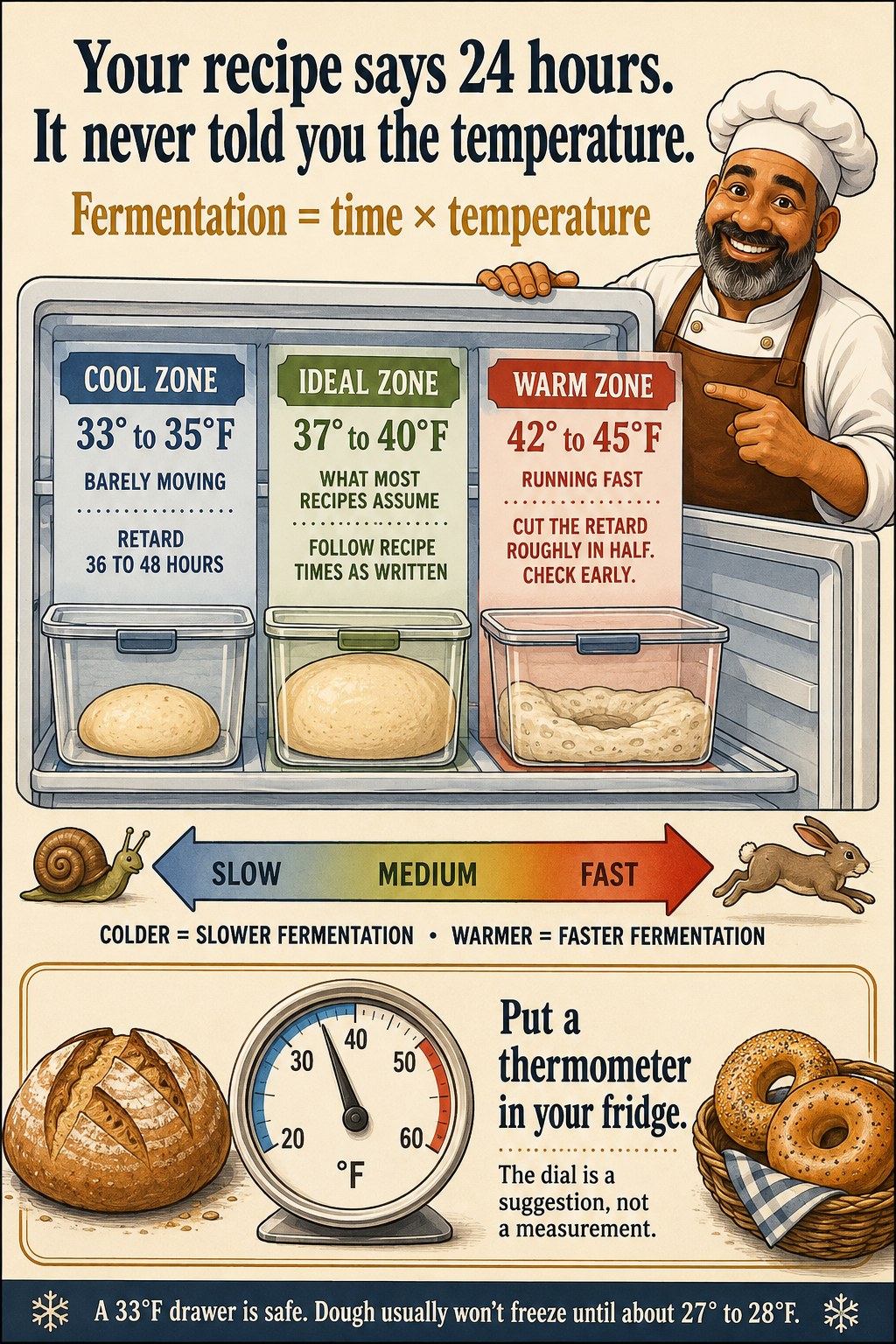
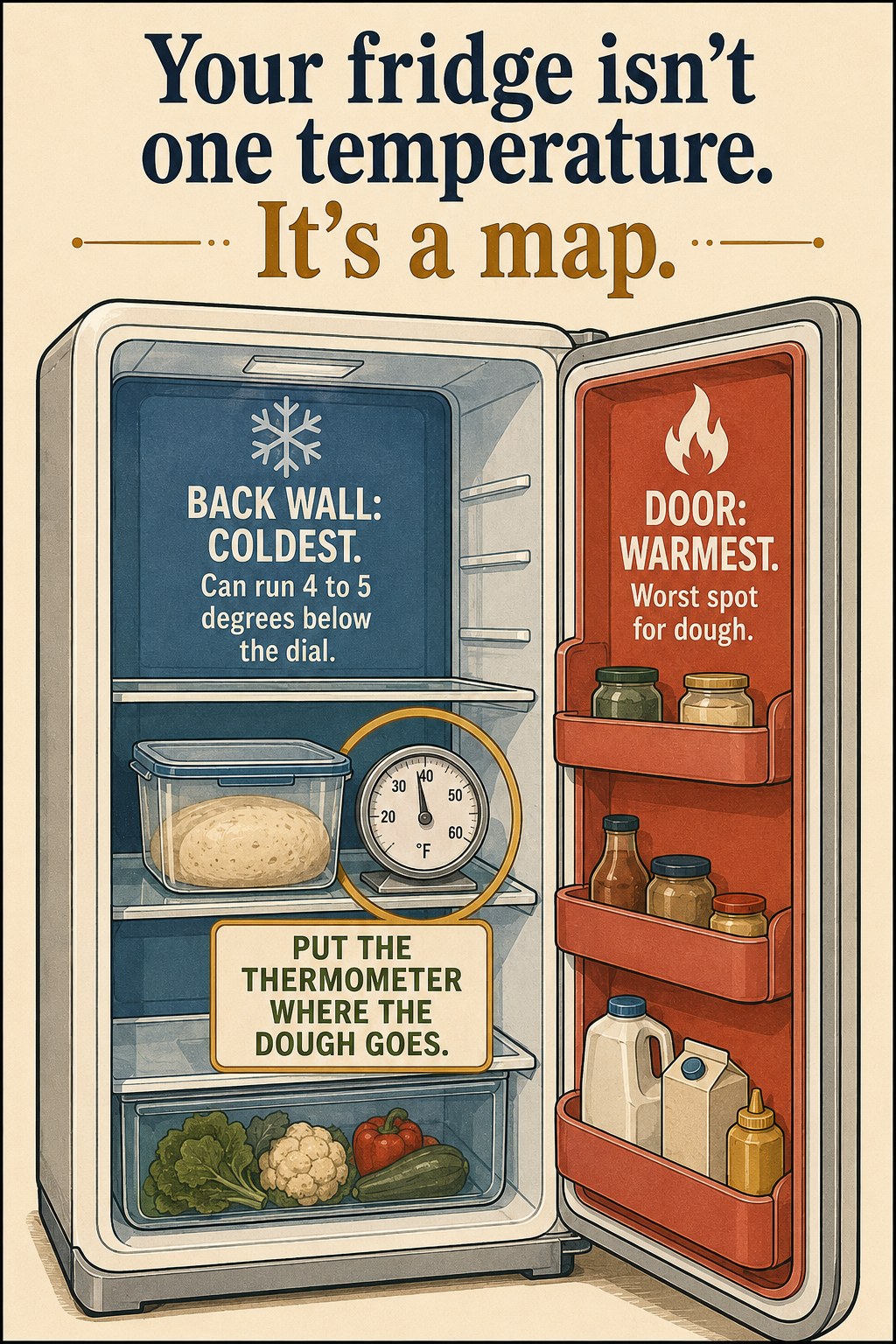
Here's the problem. The dial on your fridge is a suggestion, not a measurement. Fridges swing with how full they are, how often the door opens, whether last night's groceries went in warm, and where in the box the dough sits. The back can run four or five degrees colder than the door shelf. Plenty of fridges set to 37 spend their day at 44.
And yeast doesn't read the dial. It reads the dough.
The arithmetic nobody showed you
Fermentation speed roughly doubles for every 15 to 20 degrees you go up, and halves on the way down. Small moves in temperature are big moves in speed. So let's run the numbers on a completely ordinary kitchen. Nothing broken, nothing careless. A recipe that calls for a 24 hour retard, and a fridge that runs the way half the fridges in this community run.
| What the recipe calls for | 24 hours cold |
| The temperature it silently assumes | 38°F |
| What your dial claims | 37°F |
| What the door shelf actually holds | 45°F |
| Hidden difference | 7 degrees |
| Speed at 45° vs 38° (2x per 15°) | about 1.4x faster |
| What 24 clock hours did to your dough | 33+ hours of work |
You didn't retard for 24 hours. You retarded for 33. The recipe never lied to you. The dial did.
That extra nine hours of invisible fermentation is the flat bagel. It's the loaf that spread into a puddle the second it left the banneton, the wrinkled skin, the sour that ran past pleasant into sharp. You followed the instructions exactly. The instructions were written for a different fridge.
Now run it the other direction and watch the same math turn protective. That 33 degree drawer sits 5 degrees under the assumed speed, so the dough is crawling, covering roughly three quarters of the ground per hour. Down there, stretching the clock to 30, 36, even 48 hours isn't reckless. It's the clock making up for the thermometer. Nothing magic about the number 48. It's just distance.
Which answers the question that started this. The warm fridge is the dangerous one, not because warm is bad, but because warm is fast, and fast is unforgiving when your instructions came in hours instead of degrees. Cold errors give you time to catch them. Warm errors are already over when you open the door.
The five dollar fix
You don't need to memorize a chart and you don't need new equipment beyond one thing. Put a cheap dial or digital thermometer in your fridge, on the shelf where the dough actually goes, and leave it there a full day. Check it morning and night. That number, the real one, is worth more than any timing in any recipe you own, because now you can adjust the clock yourself instead of borrowing someone else's hours and hoping.
While you're at it, learn your fridge's map. Back wall coldest, door warmest, sometimes by five degrees. A packed fridge holds steadier than an empty one. And a fridge loaded with warm groceries at 9 PM is not at temperature again until well past midnight, which matters when that's exactly when the dough went in.
The Field Card: reading your real number
| Your real temp | What's happening | What to do |
|---|---|---|
| 33 to 35°F | Barely moving. Dough goes in young, comes out young. | Stretch the retard to 36 to 48 hours, or warm the box a few degrees. |
| 37 to 40°F | The speed most recipes assume. | Follow the written times. This is home. |
| 42 to 45°F | Running about 1.4x fast. Every written hour costs you closer to 90 minutes. | Cut the retard roughly in half and check early. |
Two footnotes worth keeping. Dough won't freeze until about 27 to 28 degrees, the salt sees to that, so a 33 degree drawer is safe, just slow. And whole grains ferment hotter: the extra enzymes and nutrition in whole wheat keep pushing even in the cold, so shave your rise targets when the bran comes to the party.
This came out of bagel week. If you want the dough that started the whole conversation, the full recipe lives in the Pantry: Sourdough New York Style Bagels.
This whole post is about one idea: temperature is the variable nobody watches. That goes double for your starter, which lives its entire life at the mercy of your kitchen's swings. The Goldie from SourHouse holds a starter in its happy zone around the clock, which is why my Vitale has one. Code HBK23 takes 10 percent off.
Give your starter a homePerfection is not required. Progress is.Henry ⭐🔥